


Blog
What IP Rating Do You Need for a 19-Inch Network Cabinet in Europe?

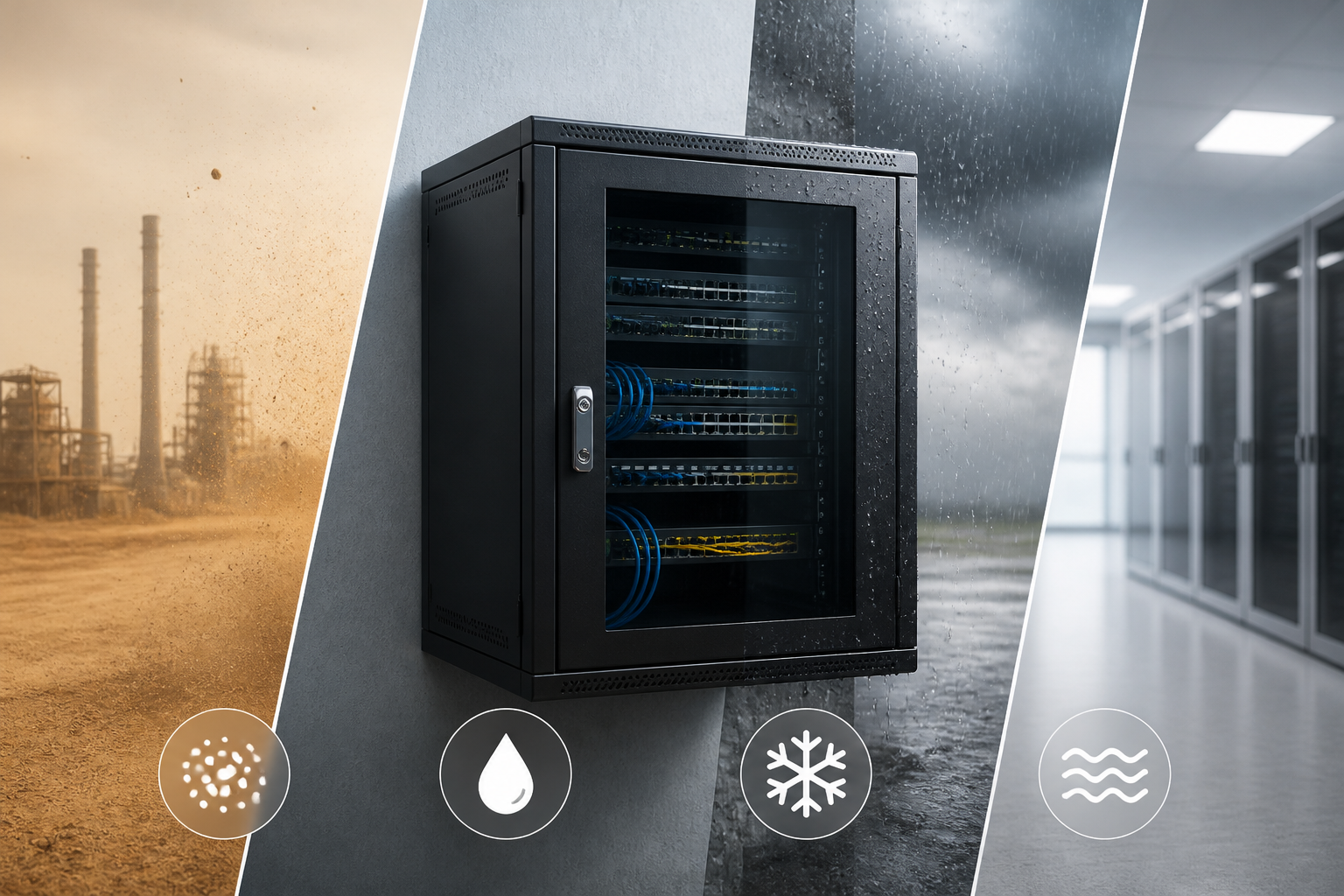
The right 19 inch network cabinet IP rating depends on the cabinet’s location and exposure. For a clean, dry office or equipment room, IP20 is often sufficient; dusty workshops commonly justify IP54 or higher; and exposed outdoor installations may require IP55, IP65 or another rating based on the expected water and dust conditions. Always verify the complete assembled cabinet, including doors, cable glands, fans and locks, against the manufacturer’s tested specification.
Choosing an enclosure by rack size alone is risky. The 19-inch dimension describes the mounting system for switches, patch panels, servers and other equipment. The IP code describes how well the enclosure resists the entry of solid particles and water. In Europe, these ratings are generally based on the IEC 60529 standard as adopted nationally, often referred to as EN 60529.
What does an IP rating mean?
An IP code, or Ingress Protection code, normally contains two numerals. The first numeral indicates protection against access to hazardous parts and the entry of solid foreign objects. The second indicates protection against water. A higher number is not automatically “better” for every network installation: it can affect heat dissipation, ventilation, maintenance and equipment compatibility.
| IP code element | What it addresses | Examples relevant to network cabinets |
|---|---|---|
| First numeral | Solid particles and access to hazardous parts | Dust, tools, wires and accidental contact |
| Second numeral | Water ingress | Drips, spraying water, water jets or temporary immersion |
For example, IP54 means limited dust ingress that must not interfere with operation, plus protection against water splashes from all directions. It does not mean the cabinet is completely dust-tight or suitable for submersion. IP65 generally means dust-tight and protected against water jets, but it still does not automatically mean temporary immersion protection. The exact test conditions matter.
How to choose a 19 inch network cabinet IP rating
Begin with the actual environment rather than selecting the highest number available. Consider dust, water, cleaning methods, humidity, condensation, temperature, impact, corrosive substances and the way cables enter the enclosure. Also consider what happens when the cabinet is opened for maintenance, because an enclosure may only achieve its stated protection when correctly closed and fitted with all specified components.
Clean indoor offices and server rooms
A standard indoor rack cabinet in a clean office, comms room or controlled data room may use an open or ventilated construction with a relatively low IP rating, commonly IP20. This can be suitable where there is no expected dripping water, washdown activity or significant airborne dust.
IP20 does not protect equipment from dust accumulation or water. It should therefore not be treated as a general-purpose rating for plant rooms, garages or unfinished construction areas. If the room has building work, textile fibres, wood dust or poor housekeeping, a more enclosed cabinet may be appropriate.
Commercial, industrial and dusty indoor locations
Workshops, warehouses, production areas and utility rooms can expose network equipment to dust, fibres, oil mist, splashes and accidental hose spray. In these locations, a sealed or gasketed cabinet may be preferable. IP44, IP54, IP55 or IP65 may be considered depending on the specific hazard assessment and the manufacturer’s test documentation.
Do not assume that an IP54 network cabinet is suitable for every industrial space. A cabinet installed near a washdown station may need protection against water jets, while one in a dry but dusty area may mainly need a higher first numeral. Chemicals, salt, abrasive dust and high temperatures can also damage seals and electronics even when the enclosure meets its IP test.
Outdoor telecom and remote network installations
Outdoor cabinets face rain, wind-driven water, dust, sunlight, condensation, insects, temperature changes and potentially snow or standing water. A cabinet described as weatherproof should have a clearly stated IP rating and installation instructions, not just a marketing label.
IP55 is often considered for outdoor equipment exposed to dust and water jets, while IP65 can provide a higher level of dust and water-jet protection. If temporary immersion is possible because of flooding or poor drainage, an IP67-rated solution may be relevant. However, IP67 testing does not automatically cover every other condition, such as continuous outdoor exposure, strong water jets or UV ageing. The site risk assessment and product documentation remain decisive.
IP rating guide for common cabinet environments
| Environment | Possible starting point | Important checks |
|---|---|---|
| Clean office or controlled IT room | IP20 or ventilated indoor cabinet | No dripping water, low dust and suitable room conditions |
| Lightly dusty commercial area | IP30 to IP44 | Dust level, accidental splashes and cleaning practices |
| Workshop or industrial room | IP54 or higher | Dust type, oil, impact, water spray and heat removal |
| Covered outdoor location | Often IP55 or IP65 | Rain direction, condensation, UV exposure and drainage |
| Exposed or flood-risk location | IP65, IP66 or IP67 as required | Water jets, immersion risk, cable entries and installation height |
These are starting points, not universal prescriptions. The required rating can only be determined after reviewing the installation conditions, applicable project specifications and the cabinet’s certification or test evidence.
Understanding the two IP numerals
First numeral: solid-particle protection
- IP2X: protection against access with a finger-sized probe, but not dust protection.
- IP3X and IP4X: increased protection against larger tools, wires and objects.
- IP5X: dust ingress is limited and must not interfere with satisfactory operation.
- IP6X: dust-tight under the relevant test conditions.
For network equipment, dust can restrict airflow, contaminate connectors and reduce the service life of fans. A dust-tight enclosure can help, but it may require filtered or conditioned ventilation to prevent overheating.
Second numeral: water protection
- IPX1 to IPX2: protection against vertically falling drops under defined conditions.
- IPX3 to IPX4: protection against spraying or splashing water.
- IPX5: protection against water jets.
- IPX6: protection against powerful water jets.
- IPX7: protection against temporary immersion under specified test conditions.
- IPX8: protection against continuous immersion when the manufacturer defines the conditions.
The water numeral should match the real exposure. A cabinet that only needs protection from occasional drips does not necessarily need IP65. Conversely, an IP44 cabinet should not be placed where pressure-washing or direct hose spray is expected.
Why a higher IP rating can create cooling problems
Network switches, routers, power supplies and servers produce heat. Ventilated rack cabinets remove heat through air movement, while sealed cabinets restrict natural airflow. If a cabinet is upgraded from an open design to a high-IP enclosure without recalculating the thermal load, internal temperatures may rise beyond the equipment manufacturer’s operating range.
Cooling options include filtered fans, roof-mounted ventilation, air-to-air heat exchangers, air conditioners and correctly sized passive heat sinks. Every fan, filter, grille and louvre can influence the final IP rating. A cabinet certified as IP65 without a vent may not retain that rating after an ordinary fan kit is installed.
Calculate the approximate heat load from the installed equipment and compare it with the cabinet cooling system’s stated capacity. Keep blanking panels fitted where required, avoid blocking intake and exhaust paths, and allow space around heat-producing devices. For sealed outdoor cabinets, also assess solar gain and internal condensation, not just the nominal room temperature.
Check cable entries, doors and accessories
Most enclosure failures occur at interfaces rather than on the main panels. Cable glands, brush strips, patching apertures, hinges, locks, removable side panels and roof fittings can all affect protection. A cabinet’s headline IP rating may apply only when its supplied covers and seals are installed exactly as tested.
For a higher-protection installation:
- Use cable glands and blanking plugs rated for the required IP level.
- Seal unused cable openings rather than leaving them open.
- Check the permitted cable diameter range for every gland.
- Inspect door and panel gaskets for correct compression and damage.
- Route cables to prevent water tracking into the cabinet.
- Use drip loops or downward cable runs where appropriate.
- Confirm that lock and ventilation accessories are part of the tested configuration.
Brush panels are convenient for cable management but may not provide the same ingress protection as a sealed gland plate. If the installation needs IP54 or above, ask the supplier how the rack’s front, rear and cable-entry arrangements achieve the stated rating.
IP rating is not the same as impact, corrosion or fire protection
IP protection addresses ingress and access; it does not define mechanical impact resistance. In Europe, impact may be described separately using an IK rating. A cabinet in a public corridor, warehouse or plant room may need both an appropriate IP rating and a suitable IK rating.
Likewise, an IP code does not guarantee resistance to salt spray, solvents, acidic vapours or aggressive cleaning chemicals. Stainless steel, coated steel, aluminium or specialist plastics may be selected according to the atmosphere. Confirm material compatibility with the cabinet manufacturer.
IP protection also does not make a cabinet fireproof, explosion-proof or automatically compliant with every electrical installation requirement. Hazardous areas, emergency power systems and specialist industrial locations may require additional product approvals and design controls.
European compliance and documentation
Ask for the manufacturer’s technical documentation before purchase. Useful evidence includes the IP rating, the standard or test method used, the tested cabinet configuration, limitations on accessories, operating temperature range and installation instructions.
For projects in Europe, the relevant national or project requirements may refer to EN 60529, the European adoption of IEC 60529. Depending on the cabinet and equipment supplied, other legislation or standards may also apply. CE marking, where applicable, is not by itself a substitute for checking the specific IP test information. The cabinet supplier should identify which claims apply to the complete product and which apply only to individual components.
A practical selection process
- Map the location. Record whether the cabinet is indoors, outdoors, sheltered, exposed, below ground or near a washdown area.
- Identify contaminants. Consider dust, fibres, oil mist, salt, chemicals, insects and condensation.
- Define water exposure. Distinguish between drips, spray, hose jets, heavy rain and temporary immersion.
- Estimate heat load. Add the power dissipation of switches, servers, UPS units and accessories.
- Choose the enclosure construction. Decide between ventilated, gasketed, sealed, insulated or climate-controlled designs.
- Verify the complete assembly. Include cable glands, fans, filters, doors, roof modules, plinths and blanking plates.
- Review maintenance. Ensure technicians can safely open the cabinet without compromising the installation afterward.
- Document the decision. Keep the datasheet, installation instructions and any project-specific approval with the equipment records.
Practical rule: Select the lowest IP rating that reliably meets the documented environmental exposure, then invest the remaining design effort in cooling, cable entry, drainage and maintainability.
Key takeaways
- The correct 19 inch network cabinet IP rating is determined by the environment, not by the 19-inch rack width.
- IP20 may suit clean, dry indoor IT rooms, while dusty or wet areas generally require a more enclosed design.
- IP54, IP55 and IP65 address different combinations of dust and water protection; read the two numerals separately.
- Higher protection can reduce ventilation, so calculate heat load before specifying a sealed enclosure.
- Cable glands, fans, filters and unused openings can reduce the protection of the complete cabinet.
- Check EN 60529 or IEC 60529 documentation, the tested configuration and any limits on accessories.
Frequently asked questions
What IP rating is suitable for a 19-inch network cabinet indoors?
For a clean, dry office or controlled equipment room, IP20 or a ventilated indoor rack may be suitable. If the room contains significant dust, moisture or cleaning spray, select a more enclosed cabinet after assessing the actual exposure.
Is IP54 enough for an outdoor network cabinet?
IP54 may be suitable for some sheltered outdoor locations, but it is not automatically appropriate for exposed rain, hose spray, flooding or prolonged weather exposure. Review the water direction, drainage, condensation, UV exposure and the manufacturer’s outdoor installation instructions.
Does IP65 mean a network cabinet can be submerged?
No. IP65 indicates dust-tight protection and protection against water jets under the applicable test conditions. Temporary immersion is addressed by IP67, while continuous immersion may require IP68 with manufacturer-defined conditions.
Will an IP-rated cabinet prevent network equipment from overheating?
No. A higher IP rating can restrict airflow and increase internal temperature. The cabinet needs an appropriately rated cooling solution, such as filtered ventilation, a heat exchanger or an air conditioner, sized for the equipment heat load.
Do cable glands affect the cabinet’s IP rating?
Yes. Cable glands, blanking plugs and other openings are part of the enclosure system. Use components compatible with the required rating and cable size, and confirm whether the supplier’s IP claim applies to the complete installed configuration.
{“@context”:”https://schema.org”,”@type”:”FAQPage”,”mainEntity”:[{“@type”:”Question”,”name”:”What IP rating is suitable for a 19-inch network cabinet indoors?”,”acceptedAnswer”:{“@type”:”Answer”,”text”:”For a clean, dry office or controlled equipment room, IP20 or a ventilated indoor rack may be suitable. If the room contains significant dust, moisture or cleaning spray, select a more enclosed cabinet after assessing the actual exposure.”}},{“@type”:”Question”,”name”:”Is IP54 enough for an outdoor network cabinet?”,”acceptedAnswer”:{“@type”:”Answer”,”text”:”IP54 may be suitable for some sheltered outdoor locations, but it is not automatically appropriate for exposed rain, hose spray, flooding or prolonged weather exposure. Review the water direction, drainage, condensation, UV exposure and the manufacturer’s outdoor installation instructions.”}},{“@type”:”Question”,”name”:”Does IP65 mean a network cabinet can be submerged?”,”acceptedAnswer”:{“@type”:”Answer”,”text”:”No. IP65 indicates dust-tight protection and protection against water jets under the applicable test conditions. Temporary immersion is addressed by IP67, while continuous immersion may require IP68 with manufacturer-defined conditions.”}},{“@type”:”Question”,”name”:”Will an IP-rated cabinet prevent network equipment from overheating?”,”acceptedAnswer”:{“@type”:”Answer”,”text”:”No. A higher IP rating can restrict airflow and increase internal temperature. The cabinet needs an appropriately rated cooling solution, such as filtered ventilation, a heat exchanger or an air conditioner, sized for the equipment heat load.”}},{“@type”:”Question”,”name”:”Do cable glands affect the cabinet’s IP rating?”,”acceptedAnswer”:{“@type”:”Answer”,”text”:”Yes. Cable glands, blanking plugs and other openings are part of the enclosure system. Use components compatible with the required rating and cable size, and confirm whether the supplier’s IP claim applies to the complete installed configuration.”}}]}