



Blog
Can You Use Cat6 Patch Cables with Cat6A Equipment? Speed, PoE and Compatibility Guide for Europe

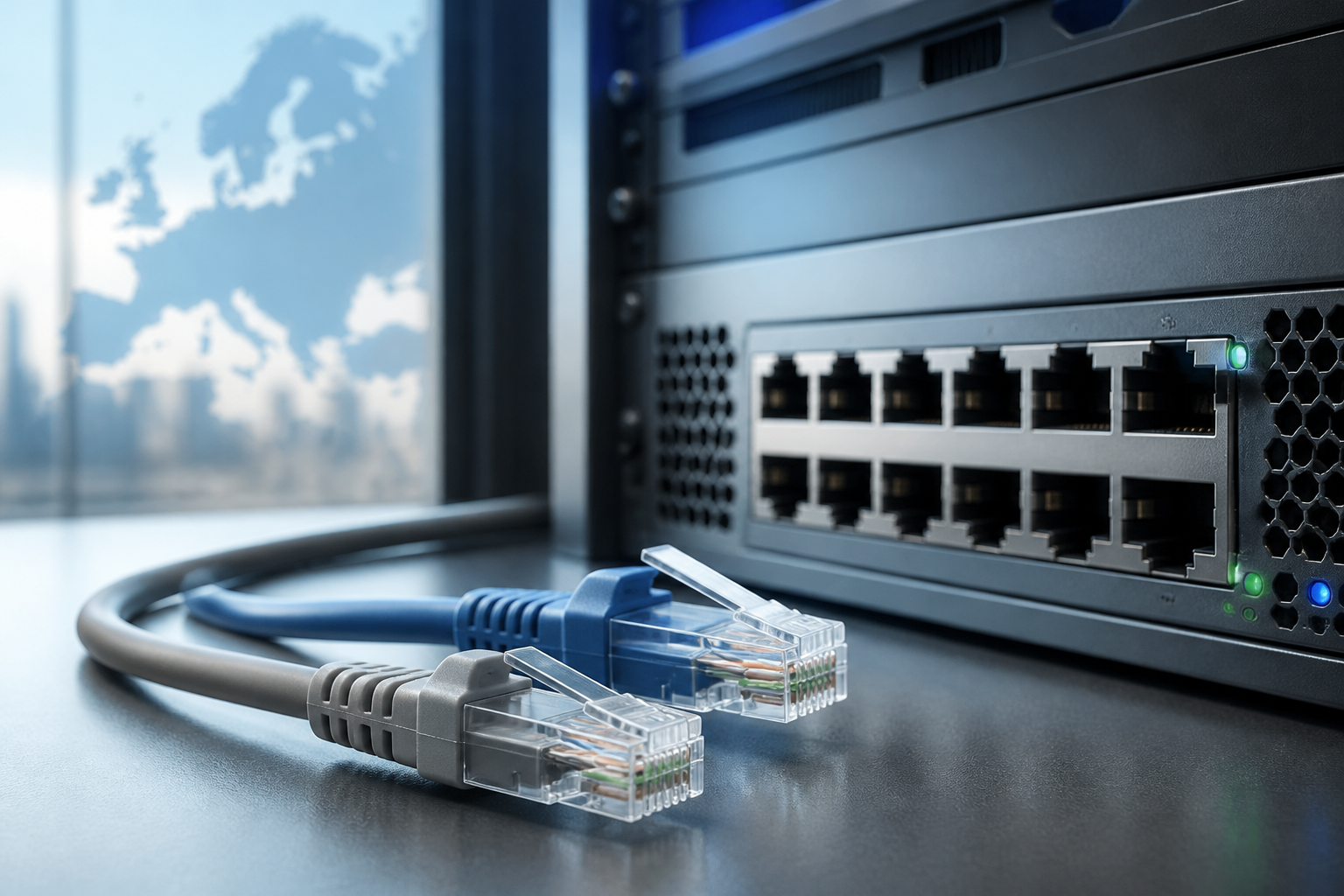
Yes, you can use Cat6 patch cables with Cat6A equipment in most installations because Cat6A network ports are generally backward compatible with Cat6 and other RJ45-based Ethernet cabling. However, the link will perform according to the weakest component. Cat6 patch leads are usually suitable for 1Gbps connections, while achieving reliable 10Gbps over a full 100-metre channel normally requires Cat6A-rated cabling throughout.
The practical answer depends on your required speed, total channel length, Power over Ethernet (PoE) load, cable construction and the installation environment. A short Cat6 patch cable connecting a Cat6A switch to a Cat6A device is normally fine. Replacing a complete Cat6A channel with Cat6 patch cords may reduce the distance or performance available for 10Gbps Ethernet.
How Cat6 and Cat6A compatibility works
Category 6 and Category 6A are performance categories for balanced twisted-pair copper cabling. Cat6A has stricter transmission requirements and is designed to support 10GBASE-T up to 100 metres when the complete permanent link and channel meet the relevant specifications. Cat6 generally supports 1Gbps up to 100 metres and may support 10Gbps over shorter distances, depending on the cable, connectors, installation quality and alien-crosstalk conditions.
Cat6A equipment normally uses familiar eight-contact modular Ethernet interfaces. As a result, a Cat6 patch cable can physically connect a Cat6A switch, patch panel, wall outlet, access point, server or network adapter. Physical connection, however, is not the same as guaranteed Category 6A performance. The equipment can negotiate a link, but its speed is still constrained by the cabling channel between the devices.
Backward compatibility does not upgrade the cable
A Cat6A switch does not turn a Cat6 patch lead into a Cat6A cable. The cable remains Cat6, with its own bandwidth, crosstalk and insertion-loss characteristics. Similarly, a Cat6A-rated patch cord can be used in a Cat6 installation, but the overall link remains limited by the lower-rated components.
Think of the connection as a chain made up of the switch port, patch cable, patch panel, horizontal cable, outlet, second patch cable and endpoint port. For certification and dependable operation, every relevant part should meet the target category and the applicable installation standard.
Can you use Cat6 patch cables with Cat6A equipment for 10Gbps?
Yes, sometimes—but not automatically over 100 metres. A short Cat6 patch cable may work at 10Gbps when connected to Cat6A equipment, particularly in a controlled rack or office connection. The maximum reliable distance depends on the complete channel, not only the switch and patch lead.
10GBASE-T is sensitive to insertion loss, return loss, near-end crosstalk and alien crosstalk from nearby cables. Cat6A is engineered with greater performance margin for 10Gbps operation at the full channel distance. Cat6 can be suitable for shorter 10Gbps links, but the exact limit should come from the cable manufacturer or a test result rather than a universal assumption.
| Installation scenario | Likely result | Recommended approach |
|---|---|---|
| Cat6 patch cable between two Cat6A devices in a rack | Usually compatible; often supports the negotiated speed | Use a short, certified lead and check the channel design |
| Cat6 patch leads at both ends of a Cat6A horizontal link | Often works, but the complete channel is no longer uniformly Cat6A | Use Cat6A patch cords where 10Gbps at 100 metres is required |
| Cat6 horizontal cabling with Cat6A switches | Usually supports 1Gbps; 10Gbps depends on length and test results | Confirm the installed cable specification and measured performance |
| High-density PoE bundle | Data compatibility may be fine, but heat and power limits matter | Follow cable, bundle-size and switch manufacturer guidance |
What speed should you expect?
The negotiated link speed is determined by the capabilities of both active devices and the quality of the copper channel. A Cat6A switch connected to a 1Gbps network adapter will operate at 1Gbps, regardless of the cable category. Conversely, two 10Gbps devices may fall back to a lower speed if the channel cannot maintain a reliable 10Gbps connection.
- 100Mbps: Cat5e or better is normally sufficient when correctly installed.
- 1Gbps: Cat6 patch cables are commonly suitable, including for many 100-metre structured cabling channels.
- 2.5Gbps and 5Gbps: Cat6 is often suitable, subject to the installation and equipment specifications.
- 10Gbps: Cat6 may work over shorter channels, while Cat6A is the safer choice for up to 100 metres.
Do not judge performance by the link light alone. A connection that links at 10Gbps may still experience errors, retransmissions or intermittent renegotiation if the channel has excessive crosstalk, poor terminations, tight bends or electromagnetic interference. For important links, test the channel with a suitable certification or qualification tester.
Cat6 patch cables, Cat6A equipment and PoE
Category marking and PoE capability are related but separate considerations. PoE is defined by Ethernet standards and implemented through the cable’s twisted pairs, conductor design, connectors and equipment. A correctly manufactured Cat6 patch cable can carry common PoE services, provided it is rated for the required current and installed within the manufacturer’s limits.
When using Cat6 patch cords with Cat6A switches or powered devices, check:
- Whether the cable supports the required PoE type and power level.
- Whether all four pairs are connected and correctly terminated.
- The conductor size, especially if the lead uses stranded conductors.
- The number of cables bundled together and the expected temperature rise.
- Whether the connector and patch panel are approved for the intended PoE application.
- Whether the cable is solid copper rather than copper-clad aluminium.
Higher-power PoE increases heating in cable bundles. A Cat6 patch lead may carry power successfully in a short, lightly bundled connection, but a large bundle in a warm cabinet requires a more careful design. Follow the relevant IEEE PoE requirements, the cabling manufacturer’s instructions and applicable European installation guidance, such as EN 50174 practices where relevant.
Connector and physical compatibility considerations
Most Cat6 and Cat6A patch cables use compatible eight-position modular plugs commonly referred to as RJ45 connectors. Even so, mechanical details can affect whether the installation is reliable.
Plug fit and boot clearance
Cat6A cables often have a larger outside diameter because they use thicker insulation, separators or shielding. A Cat6 plug may fit the port, but a dense patch panel or cable manager may not provide enough space for large boots or stiff bend-protection mouldings. Check the manufacturer’s dimensions before filling a rack with mixed cable types.
Shielding and grounding
Shielded Cat6A equipment and shielded patch cables can help manage electromagnetic interference when the entire shielded channel is installed and bonded correctly. Mixing shielded and unshielded components does not automatically create a performance problem, but it may defeat the intended shielding design. Do not connect shielded components without considering the rack, patch panel and building earthing arrangements.
Bend radius and strain
Do not sharply bend or crush a copper patch cable behind a switch or access point. Excessive strain can change the geometry of the twisted pairs and increase return loss or crosstalk. Keep patch cords within the stated minimum bend radius, avoid pulling on the plug latch and use cable management that supports rather than compresses the cable.
When should you choose Cat6A patch cables instead?
Cat6A patch leads are the better choice when you are designing for a consistent 10Gbps channel, installing new high-density server or storage connections, using long links near the channel limit, or planning for future upgrades. They also make documentation and testing simpler because the patch cords match the permanent link and the intended performance category.
Choose Cat6A patch cables when:
- The connection must support 10Gbps across a full structured cabling channel.
- The link runs through a crowded data centre or communications cabinet.
- Alien crosstalk is a known concern because of dense cable bundles.
- The project specification requires a Category 6A channel.
- You want consistent labelling, testing and future maintenance.
Cat6 remains a sensible and cost-effective option for many 1Gbps office links, short device connections and existing installations that are not expected to move to 10Gbps. Avoid replacing working cables purely because a switch has a Cat6A label; first identify the actual speed, distance and upgrade requirement.
Practical installation checklist for Europe
- Define the target: Record the required data rate, PoE power, channel length and environment.
- Check every component: Confirm the category of the horizontal cable, patch panel, outlets, patch cords and connectors.
- Confirm manufacturer ratings: Review cable diameter, bend radius, conductor type, temperature range and PoE guidance.
- Keep the channel within its design length: Include both patch leads when calculating the total channel.
- Separate power and data appropriately: Follow local installation rules and avoid unnecessary electromagnetic interference.
- Use compliant products: For European projects, consider applicable EN standards, product documentation and fire-performance requirements for the building location.
- Test before handover: Verify wire map, length, insertion loss and crosstalk performance with suitable test equipment.
- Document substitutions: If Cat6 is used in a Cat6A design, record the affected link and its tested performance.
Best practice: Use Cat6 patch cables with Cat6A equipment for short, ordinary Ethernet links when the required speed and PoE load are within specification. Use Cat6A patch cables whenever the complete channel must be treated and tested as Category 6A.
Common mistakes to avoid
- Assuming the switch determines the cable category: A Cat6A port cannot compensate for a lower-performing channel.
- Ignoring patch-cord length: Both equipment-side leads count toward the channel budget.
- Expecting every Cat6 link to run 10Gbps for 100 metres: Distance and crosstalk conditions are critical.
- Using low-quality copper-clad aluminium leads: These may not meet the expected performance or PoE requirements.
- Mixing shielded parts without a grounding plan: Shielding works as a system, not as an isolated cable feature.
- Over-bundling PoE cables: Heat can affect safety, reliability and allowable power.
Key takeaways
- Cat6 patch cables are generally physically and electrically compatible with Cat6A Ethernet equipment.
- The complete link operates at the capability of its weakest component.
- Cat6 is a common choice for 1Gbps links, while Cat6A is recommended for reliable 10Gbps operation up to 100 metres.
- PoE depends on the cable construction, connector quality, current rating and thermal installation conditions—not only the category label.
- For a new European structured cabling project, match the patch cords to the required channel category and document the installation.
Frequently asked questions
Can a Cat6 patch cable connect a Cat6A switch to a Cat6A device?
Yes. A Cat6 patch cable will normally connect a Cat6A switch and Cat6A device because the interfaces are backward compatible. The resulting link is limited by the cable and the rest of the channel, so it should not automatically be treated as a full Cat6A connection.
Will Cat6 support 10Gbps with Cat6A equipment?
It may support 10Gbps over a shorter channel, but Cat6 does not provide the same full-distance assurance as Cat6A. Check the cable manufacturer’s distance guidance and test the completed channel if 10Gbps reliability is important.
Can Cat6 patch cables carry PoE from a Cat6A switch?
Usually, yes, if the patch cable is a compliant solid-copper product with suitable connectors and current ratings. Confirm the required PoE level, conductor size, bundle conditions and manufacturer guidance before deploying high-power PoE.
Should I replace Cat6 patch cables when upgrading to a Cat6A switch?
Not necessarily. Keep the Cat6 leads if they meet the required speed, distance and PoE specifications. Replace them with Cat6A leads when you need a fully Cat6A-rated channel, maximum 10Gbps distance, improved performance margin or compliance with a project specification.
Are Cat6 and Cat6A connectors interchangeable?
Most Ethernet patch cables use compatible eight-contact modular interfaces, but cable diameter, boot shape, shielding and patch-panel clearance can differ. Verify the manufacturer’s compatibility information before using cables in a dense or shielded installation.
{“@context”:”https://schema.org”,”@type”:”FAQPage”,”mainEntity”:[{“@type”:”Question”,”name”:”Can a Cat6 patch cable connect a Cat6A switch to a Cat6A device?”,”acceptedAnswer”:{“@type”:”Answer”,”text”:”Yes. A Cat6 patch cable will normally connect a Cat6A switch and Cat6A device because the interfaces are backward compatible. The resulting link is limited by the cable and the rest of the channel, so it should not automatically be treated as a full Cat6A connection.”}},{“@type”:”Question”,”name”:”Will Cat6 support 10Gbps with Cat6A equipment?”,”acceptedAnswer”:{“@type”:”Answer”,”text”:”It may support 10Gbps over a shorter channel, but Cat6 does not provide the same full-distance assurance as Cat6A. Check the cable manufacturer’s distance guidance and test the completed channel if 10Gbps reliability is important.”}},{“@type”:”Question”,”name”:”Can Cat6 patch cables carry PoE from a Cat6A switch?”,”acceptedAnswer”:{“@type”:”Answer”,”text”:”Usually, yes, if the patch cable is a compliant solid-copper product with suitable connectors and current ratings. Confirm the required PoE level, conductor size, bundle conditions and manufacturer guidance before deploying high-power PoE.”}},{“@type”:”Question”,”name”:”Should I replace Cat6 patch cables when upgrading to a Cat6A switch?”,”acceptedAnswer”:{“@type”:”Answer”,”text”:”Not necessarily. Keep the Cat6 leads if they meet the required speed, distance and PoE specifications. Replace them with Cat6A leads when you need a fully Cat6A-rated channel, maximum 10Gbps distance, improved performance margin or compliance with a project specification.”}},{“@type”:”Question”,”name”:”Are Cat6 and Cat6A connectors interchangeable?”,”acceptedAnswer”:{“@type”:”Answer”,”text”:”Most Ethernet patch cables use compatible eight-contact modular interfaces, but cable diameter, boot shape, shielding and patch-panel clearance can differ. Verify the manufacturer’s compatibility information before using cables in a dense or shielded installation.”}}]}