



Blog
Server Cabinet vs Alternatives: Which Option Is Right?

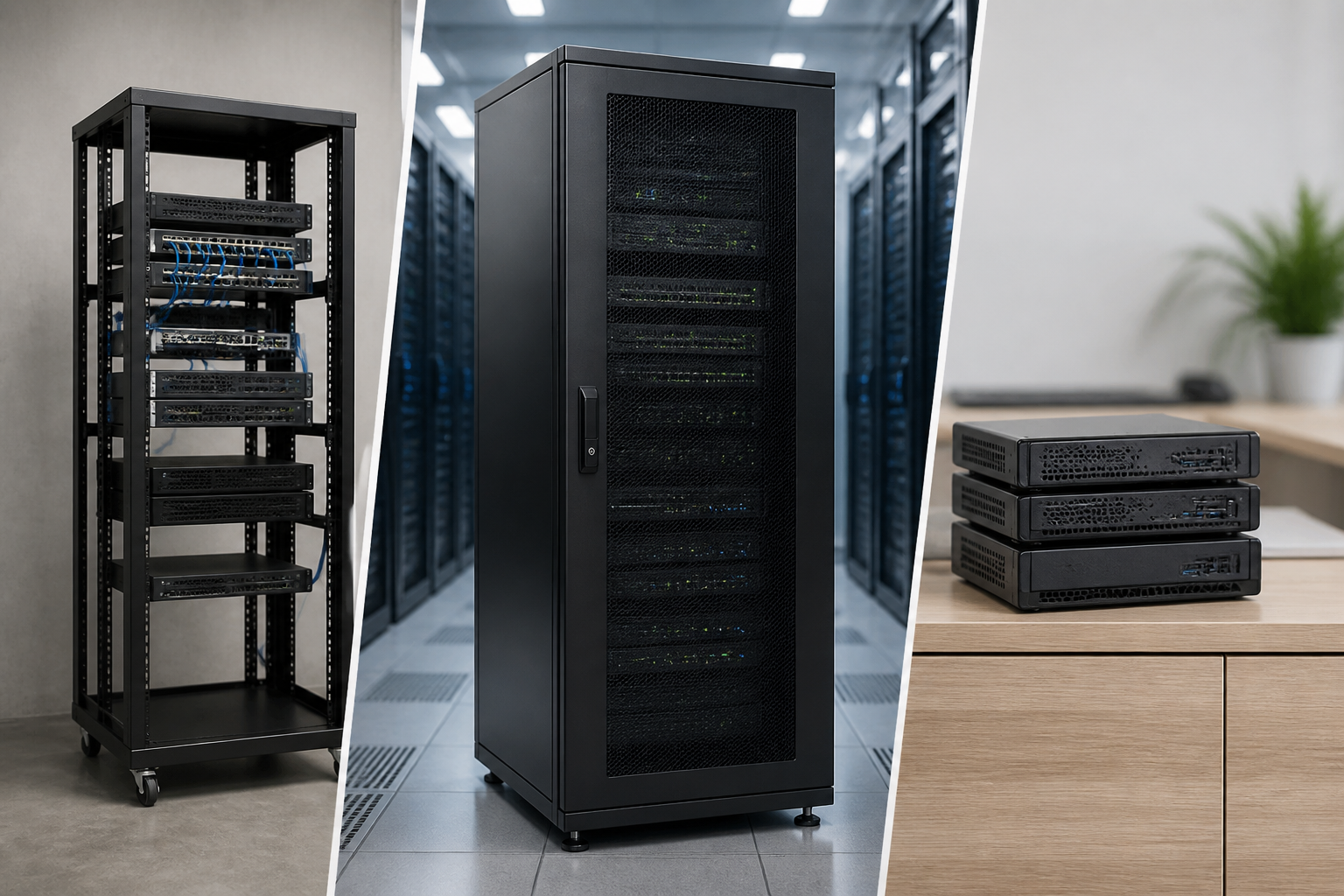
Choosing a server cabinet is not simply a question of finding a box that fits your equipment. The right rack infrastructure should suit your devices, room, cabling, security requirements, cooling approach and plans for expansion. In some environments, a fully enclosed cabinet is the best option. In others, an open-frame rack, wall-mounted enclosure or compact non-rack solution may be more practical.
This comparison explains how the main options differ and when each one makes sense, so you can make a confident decision before purchasing.
What is a server cabinet?
A server cabinet is an enclosed rack designed to house rack-mounted servers, switches, patch panels, power equipment and related infrastructure. Most are built around the widely used 19-inch rack format, with equipment installed vertically using rack units.
The enclosure normally includes front and rear access, cable management possibilities, ventilation features and mounting points for rack equipment. Depending on the installation, it may also support doors, side panels, power distribution equipment and accessories that help organise the rack.
The main advantage is that it brings equipment together in a structured, protected installation. It can provide a more controlled environment than an exposed rack, while also making the system easier to manage and expand.
Before choosing a cabinet, it is useful to review the fundamentals in How to Choose the Right Server Cabinet for Your Business.
Server cabinet vs open-frame rack
When an open-frame rack makes sense
An open-frame rack has the mounting structure of a cabinet without enclosed doors and side panels. It is often a sensible choice when easy access, visibility and straightforward installation are more important than physical protection.
- Good for accessible technical areas: Open construction allows technicians to reach equipment and cabling from multiple directions.
- Useful where airflow is already suitable: The open design does not restrict access to the surrounding air, although the room still needs an appropriate cooling strategy.
- Often practical for patching: Network and telecommunications equipment can be easier to inspect and work on when nothing obstructs the rack frame.
- Suitable for controlled rooms: An open rack may fit a dedicated technical space where dust, unauthorised access and accidental contact are already managed.
However, an open-frame rack offers less protection from dust, impact and casual interference. It also leaves cables and equipment visible, which may be unsuitable for offices, shared spaces or installations where appearance matters.
Choose an open-frame rack when the installation is in a restricted technical area and the priority is accessibility. Choose an enclosed server cabinet when you need a more complete physical enclosure or a cleaner, more finished installation.
Server cabinet vs wall-mounted network cabinet
When a wall-mounted cabinet makes sense
A wall-mounted network cabinet is designed to keep smaller rack-based systems off the floor. It can be a strong option for offices, retail spaces, branch locations and communications rooms where the equipment load is limited and floor space is valuable.
Wall-mounted enclosures are commonly considered for switches, patch panels, network termination equipment and other compact installations. They can also help keep cabling organised in locations where a floor-standing rack would be unnecessarily large.
- Choose wall mounting for limited equipment: It suits installations that do not require a tall rack or a large number of rack units.
- Consider access carefully: The mounting surface must be appropriate, and the final position should allow technicians to work safely.
- Plan cable routes before installation: Wall position, entry points and bend space can affect how cleanly the system is connected.
- Allow for growth: A small enclosure may be efficient today but restrictive if more equipment is likely to be added.
A wall-mounted cabinet is not automatically a replacement for a floor-standing server cabinet. Servers, larger power equipment and systems requiring more rack space will generally need a floor-based solution. For a closer look at this category, see the Network Cabinet Buying Guide.
Server cabinet vs network cabinet
The terms server cabinet and network cabinet are sometimes used interchangeably because both can accommodate 19-inch rack equipment. The practical distinction is usually based on the type of equipment, depth, access and installation environment rather than the name alone.
A server-focused installation may need enough depth and capacity for servers, storage equipment, power units and associated cabling. A network-focused installation may prioritise switches, patch panels, cable management and easy front or rear access. Some cabinets can support both types of equipment, but compatibility should be checked rather than assumed.
When comparing these options, check:
- The rack unit capacity required now and in the future.
- The depth of the equipment, including room for connectors and cable routing.
- Whether front and rear access is needed for installation and maintenance.
- How power, patching and horizontal or vertical cable management will be arranged.
- Whether the cabinet will be located in a dedicated technical room or a visible working area.
Use the guide to sizing a 19-inch rack to calculate the space required for servers, switches and cables before selecting an enclosure.
Server cabinet vs shelves or a non-rack enclosure
For very small systems, a shelf, cupboard or other non-rack enclosure may appear to be a convenient alternative. This can work for equipment that is not designed for rack mounting, provided the installation remains safe, accessible and well ventilated.
The limitation is that a general-purpose shelf does not automatically provide the mounting points, cable organisation or equipment separation associated with a rack system. It may also make future upgrades more difficult. Devices can become stacked, cables can become tangled and the overall arrangement may be harder to document or maintain.
A non-rack solution may be reasonable when the equipment is small, the environment is controlled and expansion is unlikely. A server cabinet is usually the more structured choice when several devices must be installed together or when the system is expected to develop over time.
How to choose between the options
Choose a server cabinet when you need protection and flexibility
Select an enclosed server cabinet when your equipment needs a dedicated, organised home with room for multiple rack devices. It is particularly appropriate when you want to manage access, reduce exposed cabling, create a professional installation or allow for future additions.
Choose an open-frame rack when access is the priority
An open rack can be suitable for a restricted technical area where technicians need frequent access and the surrounding environment is already appropriate for exposed equipment. It is less suitable where dust, accidental contact or unauthorised access is a concern.
Choose a wall-mounted cabinet when floor space is limited
A wall-mounted enclosure is a practical alternative for smaller network installations. Confirm that the equipment dimensions, weight, cabling and mounting location are all suitable before choosing this route.
Choose a non-rack solution only for simple installations
Shelves or general enclosures may suit a small, stable setup, but they can become inconvenient as equipment and cabling increase. If expansion is likely, starting with a rack-based solution may avoid a difficult redesign later.
Questions to answer before buying
- What equipment will be installed? List every device, including patch panels, power equipment and accessories.
- How much rack space is required? Allow practical space for cable routing, ventilation and future additions rather than measuring only the current devices.
- How deep and heavy is the equipment? Confirm that the cabinet or rack can accommodate the equipment dimensions and installation method.
- Where will it be installed? Consider floor or wall space, access routes, room conditions and proximity to cable pathways.
- Who needs access? A cabinet may be preferable where equipment should be enclosed, while an open rack may suit a controlled technical room.
- How will the system grow? A small saving today may create space and maintenance problems if additional devices are expected.
Find the right rack infrastructure for your installation
There is no universal best option. The right choice depends on the equipment, available space, access requirements and the level of protection and organisation your installation needs. Enclosed server cabinets offer a structured, adaptable foundation, while open racks, wall-mounted cabinets and simpler alternatives can be effective in the right environment.
Explore the rack and cabinet solutions available from RADA Networks, or contact the team if you need help narrowing down the most suitable approach for your project.